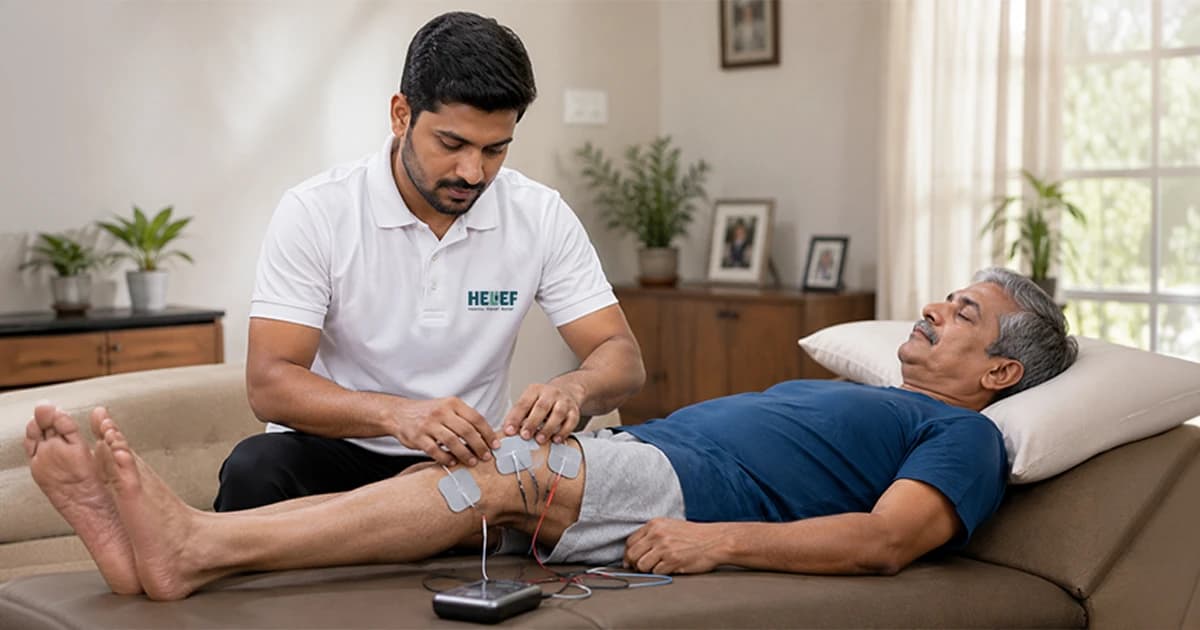
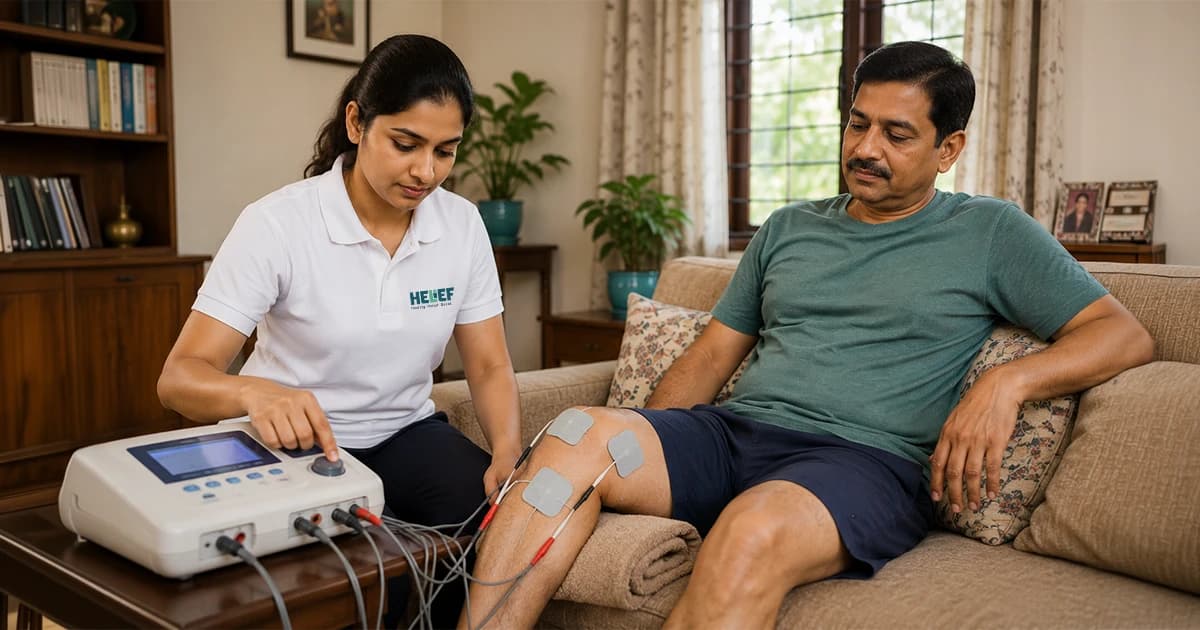
Most families in Bangalore only think about physiotherapy at home after something has already gone wrong. A parent falls. A knee replacement comes with a discharge note saying "physiotherapy recommended" — and no other instruction. Back pain that used to settle in a week stops settling.
The question that follows is almost always the same: is this actually something a physiotherapist can help with at home, or do we need a clinic? For 7 of the most common reasons people search for a physiotherapist, the honest answer is that home is not a compromise — it is often where the treatment works better.
What conditions can a home physiotherapist treat? (Quick answer)
A home physiotherapist treats most conditions a clinic does: back and neck pain, knee and joint problems, post-surgery recovery, stroke and neurological conditions, Parkinson's and dementia, balance problems in older adults, and vertigo. The deciding factor is rarely the condition itself — it is whether treatment needs fixed equipment.
That last point is the one worth holding onto. The conditions below are not a marketing list of everything we will say yes to. They are the situations where treating someone in their own home changes the quality of the treatment — not just its convenience.
The 7 conditions at a glance
| Condition | Who it usually affects | What physiotherapy targets |
|---|---|---|
| Back and neck pain | Desk workers, drivers, anyone over 35 | Mobility, core strength, posture habits |
| Knee, hip and joint pain | Older adults, arthritis, overuse injuries | Joint range, surrounding muscle strength |
| Post-surgery recovery | Knee/hip replacement, spine, fracture | Range of motion, safe weight-bearing, gait |
| Stroke and neurological | Stroke, paralysis, multiple sclerosis | Movement relearning, tone, independence |
| Parkinson's and dementia | Older adults, progressive conditions | Gait, balance, maintaining function |
| Balance problems and falls | Frail or unsteady older adults | Leg strength, reaction, home hazards |
| Vertigo and dizziness | Any age, often sudden onset | Vestibular retraining, gaze stability |
1. Back and neck pain
The most common reason people book, and the one where home visits reveal the most.
A physiotherapist who sees you in a clinic gets your account of your desk setup. One who sees you at home gets the actual chair, the actual monitor height, and the actual sofa you have been working from since the pandemic. That matters, because most persistent back pain and neck pain is maintained by something you do for eight hours a day — not by the single moment it started hurting.
Treatment usually combines hands-on work to settle the pain with a progressive strengthening plan — and the exercises are the part that lasts.
2. Knee, hip and other joint pain
Best treated where you actually use the joint.
Knee pain, hip pain and arthritis all get worse with the things a home visit can see directly: your staircase, the height of your bed, whether you have a Western or Indian toilet, how far it is to the gate. A physiotherapist can grade the exercise programme to those exact demands rather than to a generic protocol.
For arthritis in particular, the goal is rarely a cure — it is keeping the joint moving well enough that the rest of life does not shrink around it.
3. Post-surgery recovery
The condition where home physiotherapy has the clearest advantage — because getting to a clinic is the hardest.
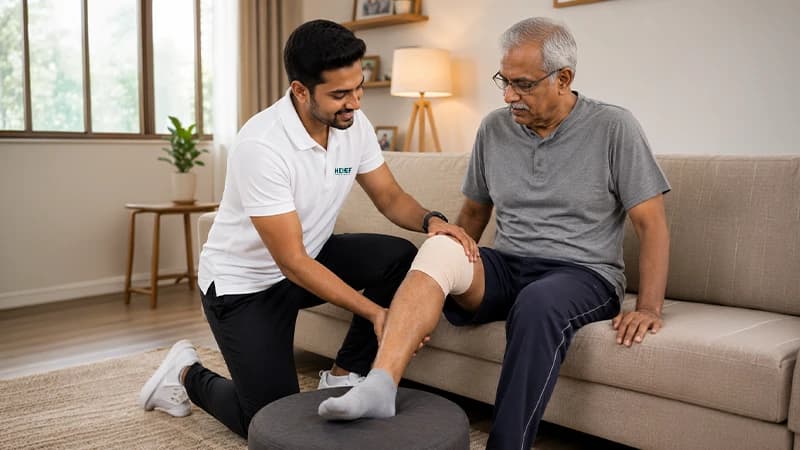
After a knee replacement, hip replacement, spine surgery or a fracture, the first weeks are exactly when travel is most painful and least safe — and also when early, correct movement matters most for the final result.
A home programme in that window covers range of motion, safe weight-bearing, wound-aware positioning, and walking practice on your own floors and steps. If you want a fuller picture of how the first visit runs, we cover it in what to expect from your first session.
4. Stroke and neurological conditions
Long rehabilitation, high travel burden — and a strong case for treating at home.
Stroke rehabilitation, paralysis and conditions like multiple sclerosis need consistent work over months, not weeks. That is a lot of clinic trips for someone whose mobility is the thing being treated — and it is usually the point at which families quietly stop going.
Working at home also means the therapist can practise the movements that actually matter to the patient: getting from bed to bathroom at night, standing from their own chair, managing their own doorway. Those are the goals people care about — and they are difficult to rehearse anywhere else.
5. Parkinson's and dementia
Physiotherapy will not stop a progressive condition — but it can change how much function is lost, and how fast.
For Parkinson's, the work centres on gait, posture, and reducing freezing episodes. For dementia, it is about keeping someone walking safely and confidently for as long as possible, in an environment they recognise. Familiarity is doing real clinical work here — a person with dementia in an unfamiliar clinic is often more agitated and less able to participate than the same person in their own living room.
Family coaching is a large part of both — the person who is there every day has more influence on the outcome than the therapist who visits twice a week.
6. Balance problems and falls in older adults
One fall reliably predicts the next — and this is one of the best-evidenced areas in physiotherapy.
Strength and balance training genuinely reduces falls in older adults. Doing it at home adds something a clinic cannot — the therapist can find the loose rug, the dark landing, the bathroom with nothing to hold onto, and fix the hazard alongside the weakness.
This overlaps closely with walking difficulty and general frailty, and the three are often treated together. If your parent has started holding furniture to cross a room, that is the signal — not a fall.

7. Vertigo and dizziness
The condition most people do not realise physiotherapy treats at all.
Vestibular rehabilitation addresses vertigo, BPPV and balance disorders through specific repositioning manoeuvres and gaze-stability training. It is often faster than people expect — and it has an obvious practical reason to happen at home: asking someone whose main symptom is spinning dizziness to travel across Bangalore for treatment is asking a lot.
How to tell whether home physiotherapy fits your situation
The condition matters less than these four questions.
| Question | Points to home care | Points to a clinic |
|---|---|---|
| Can the patient travel comfortably? | No, or only with help | Yes, independently |
| Does treatment need fixed equipment? | No, portable tools are enough | Yes, gym or hydrotherapy |
| How long is the course? | Weeks to months | A few sessions |
| Who would do the driving? | Someone with a full-time job | The patient themselves |
If you answered in the left column more than once, home physiotherapy is likely the more practical choice — and probably the more consistent one. Consistency is what determines outcomes in almost every condition on this list.
We should be straight about the exception. Late-stage sports rehabilitation, or any programme built around a full rehabilitation gym or hydrotherapy, is better served in a clinic. A physiotherapist worth hiring will tell you that — rather than take the booking.
Where Helief fits
Helief provides certified home physiotherapy across Bangalore for every condition on this list, along with sports injuries, chronic pain, paediatric physiotherapy and postnatal recovery.
Every patient starts with a proper assessment rather than a generic exercise sheet — and you get an honest estimate of how many sessions the condition is likely to need before you commit to anything. If the answer is that a clinic would serve you better, we will say so.
The bottom line
The list of conditions physiotherapy can treat at home is longer than most people assume, and the real question is almost never "is my condition on the list" — it is whether the treatment can be delivered well outside a clinic. For the large majority of musculoskeletal, post-surgical, neurological and age-related conditions, it can.
What decides the outcome is not the setting — it is whether the sessions actually happen, week after week, for as long as the condition needs. That is the part home care makes easier — and it is the reason it often outperforms the alternative.
Frequently Asked Questions
What conditions can a home physiotherapist treat in Bangalore? Most conditions a clinic treats — back and neck pain, knee, hip and joint problems, arthritis, post-surgery recovery including knee and hip replacement, stroke and neurological conditions, Parkinson's, dementia, balance problems and falls in older adults, vertigo, sports injuries, and postnatal recovery. The main exception is treatment that needs fixed gym or hydrotherapy equipment.
Is home physiotherapy as effective as going to a clinic? For most conditions, yes. Consistency matters more than setting — and home sessions are far easier to sustain over a long course. Home visits also let the physiotherapist assess and treat in the environment where the problem actually occurs, which is difficult to replicate in a clinic room.
Can physiotherapy at home help after knee replacement surgery? Yes — and the early weeks after surgery are when home care has the clearest advantage. Travel is most painful and least safe exactly when early movement matters most for the final range of motion. A home programme covers safe weight-bearing, range of motion, and walking practice on your own floors and stairs.
Does home physiotherapy work for stroke patients? Yes. Stroke rehabilitation runs over months rather than weeks — so the travel burden is what most often breaks consistency. Treating at home also lets the therapist practise the specific movements that matter to the patient, such as bed to bathroom transfers and standing from their own chair.
Can physiotherapy help with vertigo and dizziness? Yes. Vestibular rehabilitation treats vertigo, BPPV and balance disorders using repositioning manoeuvres and gaze-stability exercises. Results are often quicker than people expect — and treating at home avoids asking someone with active dizziness to travel.
How much does home physiotherapy cost in Bangalore? A standard follow-up session by a certified BPT physiotherapist typically ranges from ₹650 to ₹1,250, with the initial assessment usually a little higher. Our guide to home physiotherapy cost breaks down what a session includes and how to budget a full course.
Helief provides home physiotherapy across Bangalore, covering every condition above with certified BPT physiotherapists. Not sure whether yours is suitable? Book a home visit and we will give you an honest assessment before you commit to a course of treatment.