Gait Training Physiotherapy for Walking Difficulty at Home
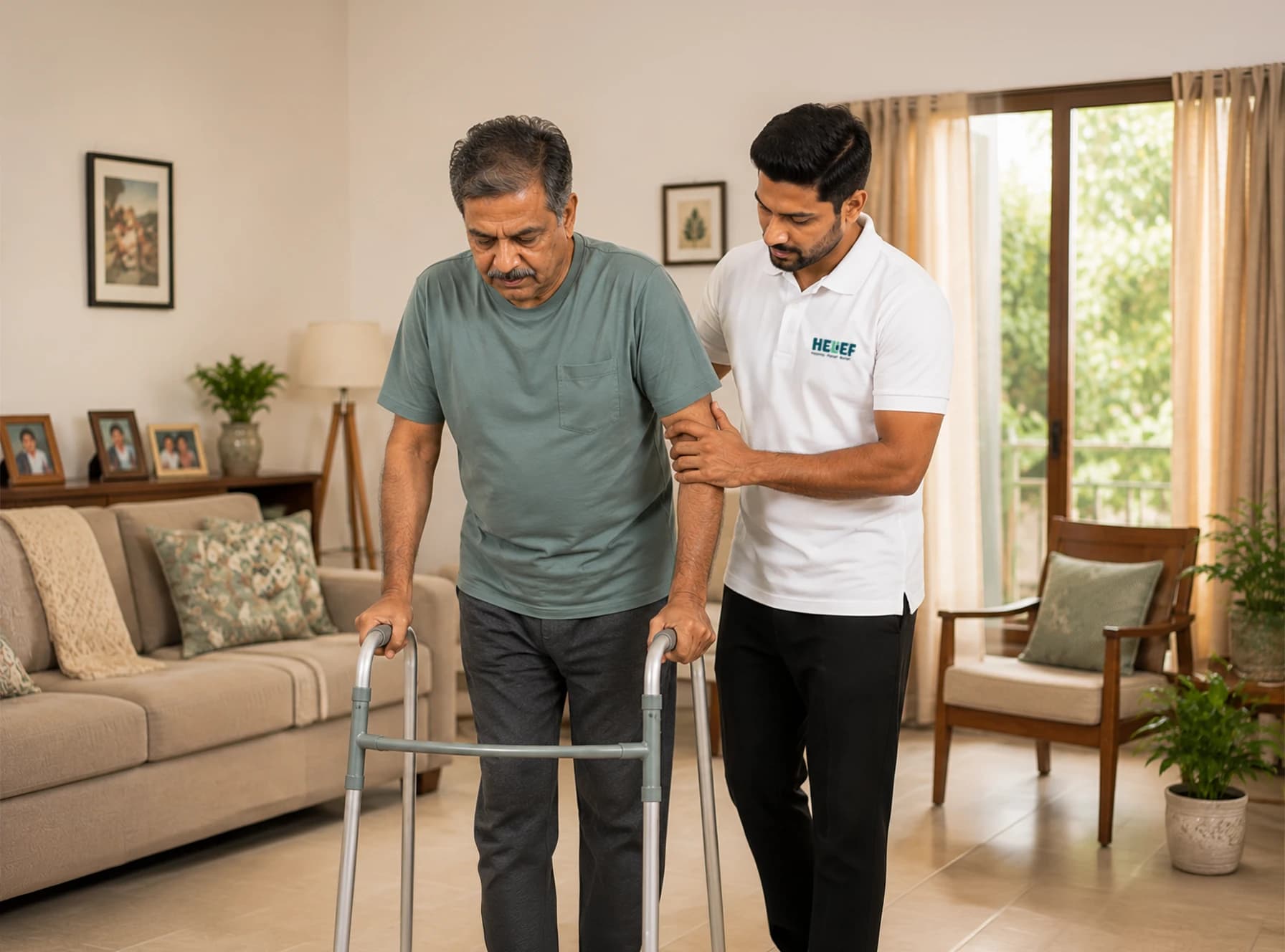
When a parent starts shuffling, tires after a few steps, or holds the wall to cross a room, walking itself has become the problem. Our certified physiotherapists come to your home in Bangalore to retrain how they walk, rebuild stamina, and get them moving further with less effort.
- 5-Star Rated
- 100+ Happy Patients
- Certified Physiotherapists
Certified Physiotherapists
Verified & background-checked
Quick answer
Gait training is physiotherapy that retrains the mechanics of walking — step length, foot clearance, rhythm, and posture — alongside the leg strength and stamina that walking demands. For older adults it restores walking distance, reduces the effort each step takes, and makes sure any walking aid is the right one and correctly fitted.
Understanding it
What is walking difficulty?
Walking feels automatic, but it is a coordinated skill that depends on strength, joint movement, balance, sensation in the feet, and stamina all working together. When any of those decline, the body compensates — steps get shorter, the feet lift less clearly off the floor, the stride becomes uneven, and walking starts to take real concentration and effort. Families usually notice the result before the cause: a parent who walks more slowly, stops to rest, or quietly stops going out.
Gait training addresses the walking itself rather than treating it as a side effect of something else. A physiotherapist analyses how the person actually walks, identifies which part of the pattern has broken down, and rebuilds it through targeted strengthening, movement practice, and graded walking. Where a stick, walker, or frame is genuinely needed, it is chosen and fitted properly — a poorly sized aid makes walking harder, not easier.
Signs that walking has become a problem
- Shorter, slower, or shuffling steps
- Feet not lifting clearly off the floor, catching on thresholds or rugs
- Needing to stop and rest partway across a room or down the street
- Walking with a wider stance, or leaning on furniture and walls
- An uneven walk — limping, dragging one leg, or favouring one side
- Struggling with stairs, kerbs, or uneven ground
- Going out less because walking has become too tiring
What causes walking difficulty
- Weakness in the hips, thighs, and calves that drive each step
- Arthritis, joint stiffness, or pain that shortens the stride
- Neurological conditions such as Parkinson's or the after-effects of a stroke
- Reduced sensation in the feet, making foot placement less certain
- Breathlessness or low cardiac fitness that limits walking distance
- Foot problems, poor footwear, or long-standing gait habits
- Extended bed rest or a hospital stay that eroded walking practice
- A walking aid that is the wrong type, wrong height, or used incorrectly
Walking safely
What makes walking harder over time
Don't wait it out
When to see a physiotherapist
If any of these sound familiar, an assessment is worth booking. Treating it early usually means a faster, fuller recovery.
If walking has become noticeably slower, shorter, or more effortful
If your parent has started holding walls or furniture to move around
If walking distance is shrinking — no longer reaching the gate or the shops
If stairs, kerbs, or uneven ground have become difficult
After a hospital stay, fracture, or illness that interrupted normal walking
If a stick or walker is being used but was never properly fitted
Seek medical care first
These signs need a doctor or emergency care — not physiotherapy. Please get urgent medical attention if you notice:
- A sudden change in walking, with slurred speech, facial droop, or one-sided weakness (possible stroke — call emergency services)
- New numbness, weakness, or loss of control in one or both legs (needs urgent medical review)
- Walking difficulty alongside new bladder or bowel changes (needs emergency assessment)
- Severe calf pain, swelling, or redness in one leg (possible clot — seek medical care)
- Chest pain or severe breathlessness brought on by walking (seek medical care)
Our approach
How Helief treats walking difficulty at home
We begin by watching your parent walk in their own home — down the hallway, to the bathroom, up any steps — because that reveals far more than an assessment in a clinic room. The physiotherapist identifies which element has broken down: whether it is hip and calf weakness shortening the stride, stiffness limiting the movement, uncertain foot placement, or simply a loss of stamina. We also check any walking aid already in use, since the wrong height or type quietly makes walking worse.
Treatment then rebuilds walking directly. Progressive strengthening restores the muscles that power each step, movement work restores the range the stride needs, and supervised walking practice retrains rhythm, step length, and foot clearance. Distance is built gradually and deliberately, and the routes that matter most — bedroom to bathroom, front door to gate — are practised until they feel manageable. Families are shown how to encourage safe walking between visits without hovering or taking over.
Treatment techniques
Evidence-based methods we use
Gait assessment & retraining
Analysing the walking pattern step by step, then retraining step length, rhythm, foot clearance, and posture.
Lower-limb strengthening
Progressive work on the hips, thighs, and calves — the muscles that generate and control each step.
Walking-aid assessment & fitting
Choosing the right stick, walker, or frame where one is needed, setting it to the correct height, and teaching correct use.
Walking endurance building
Graded walking practice that steadily extends distance and reduces how much effort each journey takes.
Stairs, kerbs & uneven ground
Practising the harder surfaces — steps, thresholds, slopes — that most often limit where your parent can go.
Family & carer coaching
Showing the family how to encourage and supervise safe walking practice between sessions.
Recovery timeline
What progress typically looks like
Every recovery is individual — this is a general guide, not a guarantee. Your physiotherapist sets realistic milestones after the first assessment.
- 1Getting started
Analyse the walk
A full gait assessment in the home, a check of any walking aid in use, and clear goals for distance and independence.
- 2Weeks 1–4
Rebuild the foundations
Strengthening and movement work that restores the power and range each step depends on, with early gait practice.
- 3Weeks 4–8
Extend distance & confidence
Longer supervised walks, stair and kerb practice, and steady progress on the routes that matter day to day.
- 4Ongoing
Keep walking
A simple daily walking routine that protects the gains and keeps stamina and step quality from slipping back.
Why at home
The advantage of treating walking difficulty at home
Walking is retrained on your actual floors, thresholds, and staircase — not a clinic corridor
The routes that matter most, like bedroom to bathroom, are practised where they happen
Any walking aid is fitted to the real doorways and turns it has to navigate
No tiring journey to a clinic for someone for whom walking is already the difficulty
Family see exactly how to encourage safe walking practice between visits
Certified physiotherapists, clinical standards, delivered at home
Every walking difficulty treatment plan is delivered by a qualified, vetted physiotherapist following proper assessment and safety protocols — built around your goals and paced to your recovery.
Book Now
Start walking difficulty treatment at home
Share your details and we'll call you back to arrange a home visit across Bangalore. A certified physiotherapist assesses the cause before any treatment begins.
Locations we serve
Walking Difficulty physiotherapy across Bangalore
Our certified physiotherapists visit homes right across the city. Pick your area, or message us to check availability near you.
Not on the list? WhatsApp us — we cover much of Bangalore.
FAQ
Walking Difficulty — your questions
Related conditions
You may also be looking for
Balance Problems & Falls
Rebuilding steadiness, strength, and confidence so a fall doesn't take away independence.
Learn MoreFrailty & Weakness
Rebuilding strength and stamina to reverse age-related decline and protect independence.
Learn MorePost-Hospitalisation Recovery
Rebuilding the strength and mobility lost during a hospital stay, safely at home.
Learn MoreParkinson's Disease
Maintaining movement, balance, and independence with Parkinson's — through home physiotherapy.
Learn MoreStroke Rehabilitation
Rebuilding movement, strength, and independence after a stroke — at home in Bangalore.
Learn MoreStart your recovery journey this week
Book a home visit and let a certified physiotherapist come to you — no travel, no waiting rooms.