Parkinson's Physiotherapy at Home in Bangalore
Parkinson's gradually changes how the body moves — but the right physiotherapy helps people stay mobile, steady, and independent for far longer. Our certified neuro physiotherapists bring evidence-based Parkinson's care to your home in Bangalore, focused on movement, balance, and quality of life.
- 5-Star Rated
- 100+ Happy Patients
- Certified Physiotherapists
Certified Physiotherapists
Verified & background-checked
Quick answer
Parkinson's physiotherapy helps people maintain movement, balance, posture, and independence as the condition progresses. It can't cure Parkinson's, but strong evidence shows that regular, targeted exercise — big-amplitude movements, gait and balance training, and cueing strategies — improves mobility, reduces falls, and supports quality of life. Home-based care makes that consistency sustainable.
Understanding it
What is parkinson's disease?
Parkinson's disease is a progressive neurological condition in which the brain gradually loses cells that produce dopamine, a chemical essential for smooth, controlled movement. Over time this causes slowness of movement, stiffness, tremor, small shuffling steps, a stooped posture, and problems with balance — changes that build slowly and affect everyday function.
Physiotherapy is one of the most valuable non-medication treatments for Parkinson's. It doesn't cure or reverse the condition, but a large body of evidence shows that regular, targeted exercise keeps people moving better and for longer — improving walking, balance, and posture, reducing the risk of falls, and helping maintain the independence and confidence the condition threatens.
Common symptoms
- Slowness of movement (bradykinesia) — everyday actions become effortful
- Muscle stiffness and rigidity
- Tremor, often starting in a hand at rest
- Small, shuffling steps and a stooped posture
- 'Freezing' — feeling stuck, especially when starting to walk or turning
- Balance problems and an increased risk of falls
Common causes
- Progressive loss of dopamine-producing cells in the brain
- The exact trigger is usually unknown (idiopathic Parkinson's)
- Age — risk increases with age, though younger onset occurs
- Genetic factors in a minority of cases
- Possible environmental factors under ongoing research
Risk factors
What raises the likelihood
Don't wait it out
When to see a physiotherapist
If any of these sound familiar, an assessment is worth booking. Treating it early usually means a faster, fuller recovery.
Soon after diagnosis — starting exercise early helps maintain function
If walking, balance, or freezing episodes are becoming a problem
If falls, or a growing fear of falling, are creeping in
If posture or stiffness is affecting daily activities
At any stage — physiotherapy helps throughout the course of Parkinson's
Seek medical care first
These signs need a doctor or emergency care — not physiotherapy. Please get urgent medical attention if you notice:
- A fall causing a head injury, severe pain, or inability to move a limb (seek medical care)
- A sudden, marked worsening of movement or confusion (may need medical review)
- Choking, difficulty swallowing, or recurrent chest infections
- New severe dizziness or fainting on standing
Our approach
How Helief treats parkinson's disease at home
Every plan starts with an assessment of how Parkinson's is affecting movement, gait, balance, posture, and daily function — and what matters most to the person, whether that's walking safely, getting out of a chair, or reducing freezing. Because Parkinson's affects everyone differently and changes over time, we review and adapt the programme regularly.
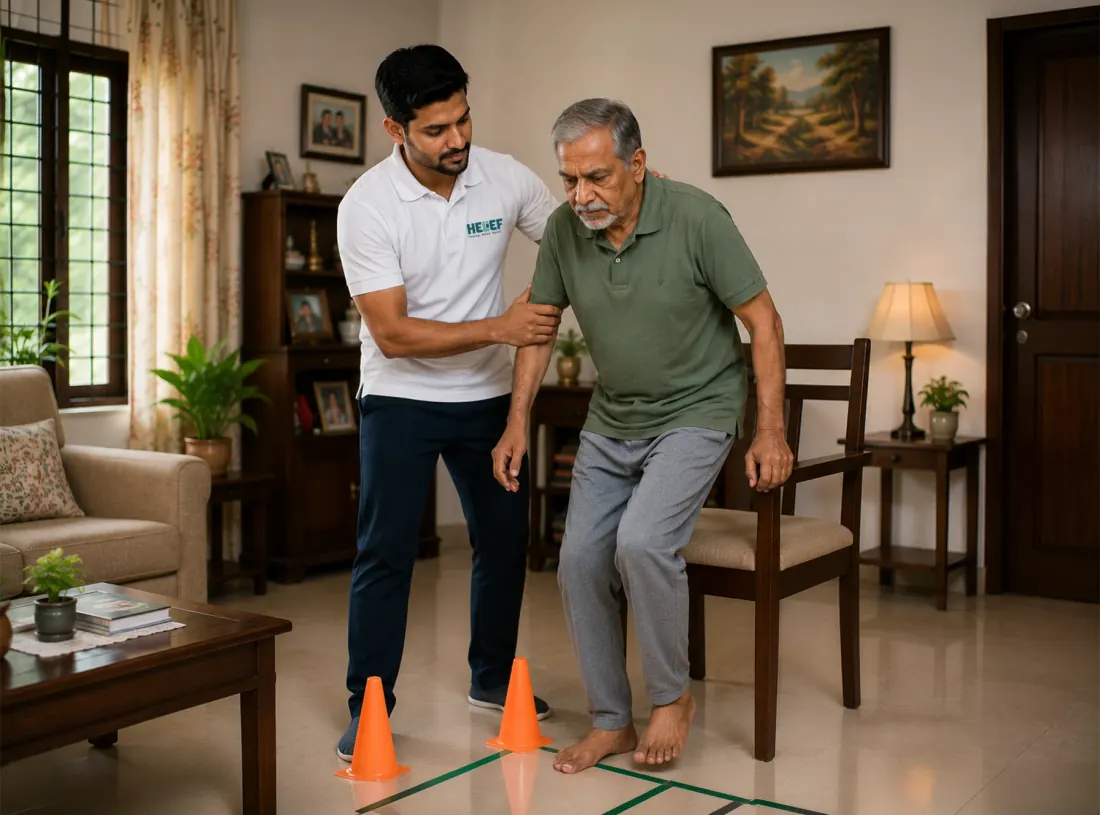
The work centres on the exercise strategies that evidence supports for Parkinson's: large-amplitude, exaggerated movements to counter the shrinking of movement, gait and balance training, posture work, and cueing techniques — visual and rhythmic cues that help overcome freezing and keep walking smooth. We also coach the person and family on safe daily routines and fall prevention.
Treatment techniques
Evidence-based methods we use
Large-amplitude movement training
Exaggerated, 'big' movements that directly counter the slowness and shrinking of movement Parkinson's causes.
Gait retraining & cueing
Visual and rhythmic cueing strategies that overcome freezing and restore a smoother, more confident walk.
Balance & fall prevention
Targeted balance training to reduce the falls that are one of the biggest risks in Parkinson's.
Posture & flexibility work
Exercises to counter the stooped posture and stiffness, keeping the body upright and mobile.
Strength & endurance
Maintaining muscle strength and stamina to support everyday activity and independence.
Daily-routine & family coaching
Practical strategies for transfers, turning in bed, and safe daily movement, with the family involved.
Recovery timeline
What progress typically looks like
Every recovery is individual — this is a general guide, not a guarantee. Your physiotherapist sets realistic milestones after the first assessment.
- 1First few weeks
Assess & establish routine
We assess movement and falls risk and build a targeted, sustainable exercise routine you can keep up.
- 2First few months
Build mobility & confidence
Steady improvements in walking, balance, and posture, with cueing strategies to manage freezing.
- 3Ongoing management
Maintain function
Regular physiotherapy to hold onto mobility and independence and slow functional decline as the condition evolves.
- 4As needs change
Adapt the plan
The programme is reviewed and adapted over time, always matched to the person's current stage and goals.
Why at home
The advantage of treating parkinson's disease at home
Regular sessions that fit the ongoing nature of Parkinson's, without tiring clinic trips
The therapist sees and fixes the real fall hazards in the home
Cueing and movement strategies practised in the exact spaces the person moves through daily
Family coached to support safe daily activity and confidence
Certified physiotherapists, clinical standards, delivered at home
Every parkinson's disease treatment plan is delivered by a qualified, vetted physiotherapist following proper assessment and safety protocols — built around your goals and paced to your recovery.
Book Now
Start parkinson's disease treatment at home
Share your details and we'll call you back to arrange a home visit across Bangalore. A certified physiotherapist assesses the cause before any treatment begins.
Locations we serve
Parkinson's Disease physiotherapy across Bangalore
Our certified physiotherapists visit homes right across the city. Pick your area, or message us to check availability near you.
Not on the list? WhatsApp us — we cover much of Bangalore.
FAQ
Parkinson's Disease — your questions
Related conditions
You may also be looking for
Stroke Rehabilitation
Rebuilding movement, strength, and independence after a stroke — at home in Bangalore.
Learn MoreParalysis
Restoring movement, preventing complications, and rebuilding independence after paralysis — at home.
Learn MoreMultiple Sclerosis
Managing fatigue, balance, and mobility with MS — through home physiotherapy.
Learn MoreBell's Palsy
Facial retraining to restore movement and symmetry after Bell's palsy — at home.
Learn MoreStart your recovery journey this week
Book a home visit and let a certified physiotherapist come to you — no travel, no waiting rooms.