Paralysis Physiotherapy at Home in Bangalore
Paralysis changes daily life profoundly — but with the right rehabilitation, most patients can regain function, avoid serious complications, and rebuild independence. Our certified neuro physiotherapists bring expert, consistent paralysis care to your home in Bangalore, working patiently toward every gain that's possible.
- 5-Star Rated
- 100+ Happy Patients
- Certified Physiotherapists
Certified Physiotherapists
Verified & background-checked
Quick answer
Paralysis physiotherapy restores movement where recovery is possible, prevents the complications that immobility brings — contractures, pressure sores, chest infections — and rebuilds as much independence as the condition allows. Whether the cause is a stroke, spinal injury, or nerve damage, consistent home-based rehab is central to the best possible outcome.
Understanding it
What is paralysis?
Paralysis is the loss of muscle function in part of the body — it may be partial (weakness, sometimes called paresis) or complete, and affect one limb, one side (hemiplegia), the lower body (paraplegia), or all four limbs (quadriplegia). It results from a breakdown in the signals between the brain, spinal cord, nerves, and muscles, most often after a stroke, spinal cord injury, or nerve damage.
Physiotherapy for paralysis has two jobs that run side by side. The first is restoring movement wherever the nervous system allows it, through repetition and retraining. The second — just as important — is preventing the serious complications that immobility causes: stiff, fixed joints (contractures), pressure sores, chest infections, and circulation problems. Done well, rehabilitation protects health while rebuilding function.
Common symptoms
- Loss of movement or marked weakness in the affected part of the body
- Muscle stiffness or spasticity, or in some cases floppiness
- Loss of sensation in the affected area
- Difficulty with balance, sitting, standing, or walking
- Reduced ability to carry out everyday tasks independently
- Risk of secondary problems — pressure sores, contractures, swelling
Common causes
- Stroke (the most common cause of one-sided paralysis)
- Spinal cord injury from an accident or fall
- Nerve damage or compression
- Neurological conditions such as multiple sclerosis or Guillain-Barré syndrome
- Brain or spinal infection or tumour
- Cerebral palsy and other conditions present from birth
Risk factors
What raises the likelihood
Don't wait it out
When to see a physiotherapist
If any of these sound familiar, an assessment is worth booking. Treating it early usually means a faster, fuller recovery.
As soon as possible after the causing event, to protect and begin activating movement
If the patient is bed-bound and at risk of pressure sores or stiffness
If therapy has been inconsistent since discharge
If you need training in safe transfers, turning, and daily care
At any stage — physiotherapy still prevents complications and maximises function
Seek medical care first
These signs need a doctor or emergency care — not physiotherapy. Please get urgent medical attention if you notice:
- New or worsening paralysis, numbness, or loss of bladder/bowel control (seek urgent medical care)
- A red, broken, or blackened area of skin over a pressure point (developing pressure sore)
- Fever, breathlessness, or a productive cough (possible chest infection)
- A hot, swollen, painful calf (possible blood clot / DVT)
Our approach
How Helief treats paralysis at home
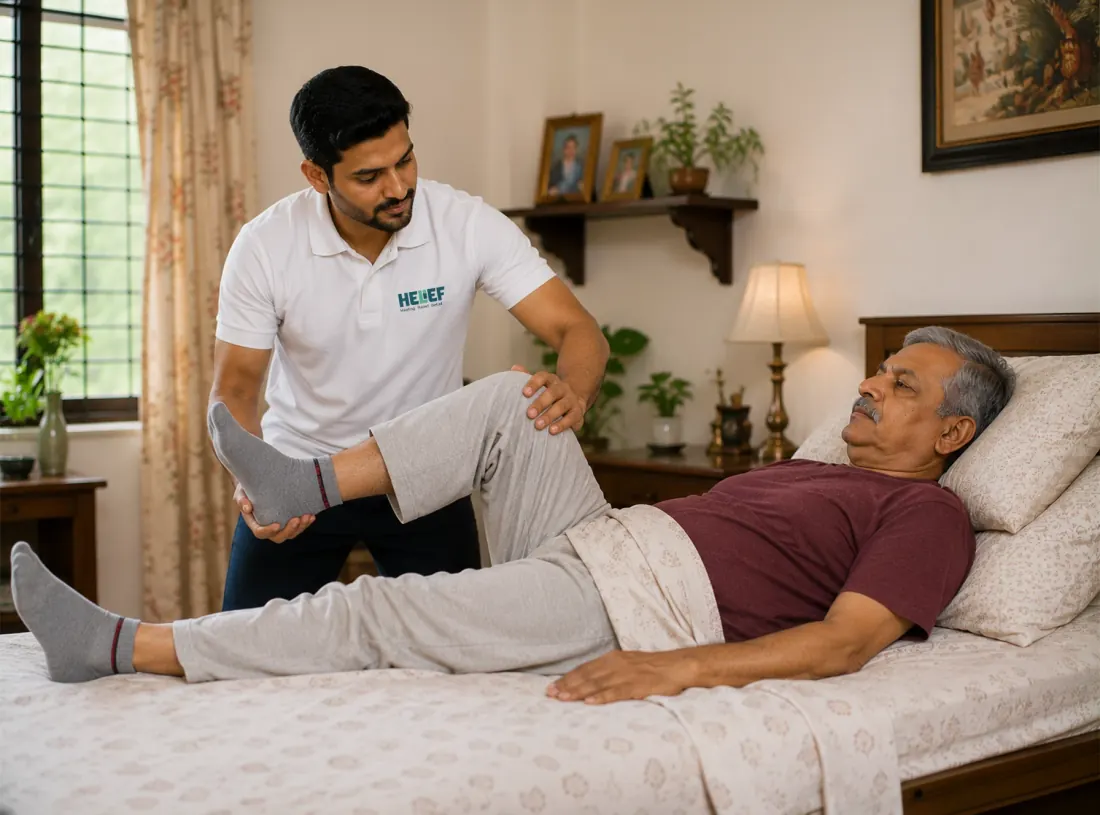
Every plan starts by understanding the cause and pattern of the paralysis, what movement and sensation remain, and the risks that need protecting against. From this we build a programme that works on two fronts at once: recovering function where the nervous system allows, and actively preventing the complications that cause the most harm during immobility.
The work combines movement retraining and strengthening with careful positioning, stretching to prevent contractures, and coaching the family on safe transfers, turning, and skin care. As ability returns, we progress toward sitting, standing, transfers, and — where possible — walking, always pacing the programme to what the patient can safely manage.
Treatment techniques
Evidence-based methods we use
Movement retraining & strengthening
Repetition-based retraining and strengthening of the affected muscles wherever the nervous system allows recovery.
Contracture prevention
Regular stretching and positioning to keep joints mobile and prevent the fixed stiffness immobility causes.
Positioning & pressure care
Guidance on positioning and turning to protect the skin and prevent pressure sores during immobility.
Transfers & mobility training
Rebuilding sitting, transfers, standing, and — where possible — walking, safely and progressively.
Spasticity management
Stretching and movement to manage muscle tightness, alongside any medical treatment prescribed.
Caregiver training
Teaching the family safe handling, transfers, and daily care — essential to protect the patient and prevent complications.
Recovery timeline
What progress typically looks like
Every recovery is individual — this is a general guide, not a guarantee. Your physiotherapist sets realistic milestones after the first assessment.
- 1Early phase
Protect & prevent
The first priority is preventing complications — positioning, stretching, skin care — while beginning to activate any movement.
- 2Active rehab
Rebuild movement & strength
Repetition-based retraining and strengthening work to recover function wherever the nervous system allows.
- 3Functional phase
Restore independence
Progressing to transfers, sitting, standing, and mobility, rebuilding as much daily independence as possible.
- 4Ongoing
Maintain & adapt
A sustained programme to hold onto gains, prevent complications, and keep improving where recovery continues.
Why at home
The advantage of treating paralysis at home
Frequent, consistent rehab without the enormous difficulty of moving a paralysed patient to a clinic
The therapist protects the skin and joints in the patient's actual bed and chair
Family is trained in safe transfers, turning, and daily care between visits
Care in familiar surroundings supports comfort, dignity, and engagement
Certified physiotherapists, clinical standards, delivered at home
Every paralysis treatment plan is delivered by a qualified, vetted physiotherapist following proper assessment and safety protocols — built around your goals and paced to your recovery.
Book Now
Start paralysis treatment at home
Share your details and we'll call you back to arrange a home visit across Bangalore. A certified physiotherapist assesses the cause before any treatment begins.
Locations we serve
Paralysis physiotherapy across Bangalore
Our certified physiotherapists visit homes right across the city. Pick your area, or message us to check availability near you.
Not on the list? WhatsApp us — we cover much of Bangalore.
FAQ
Paralysis — your questions
Related conditions
You may also be looking for
Stroke Rehabilitation
Rebuilding movement, strength, and independence after a stroke — at home in Bangalore.
Learn MoreMultiple Sclerosis
Managing fatigue, balance, and mobility with MS — through home physiotherapy.
Learn MoreParkinson's Disease
Maintaining movement, balance, and independence with Parkinson's — through home physiotherapy.
Learn MoreSpine Surgery
Careful, guided rehabilitation after back or neck surgery — rebuilding movement and confidence at home.
Learn MoreStart your recovery journey this week
Book a home visit and let a certified physiotherapist come to you — no travel, no waiting rooms.