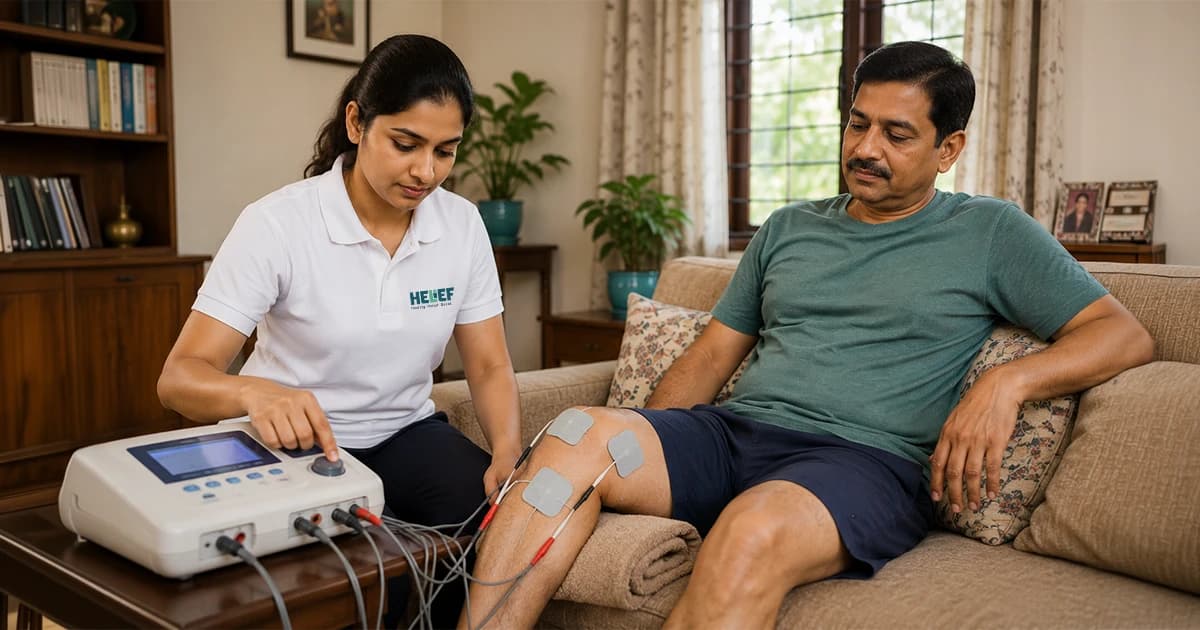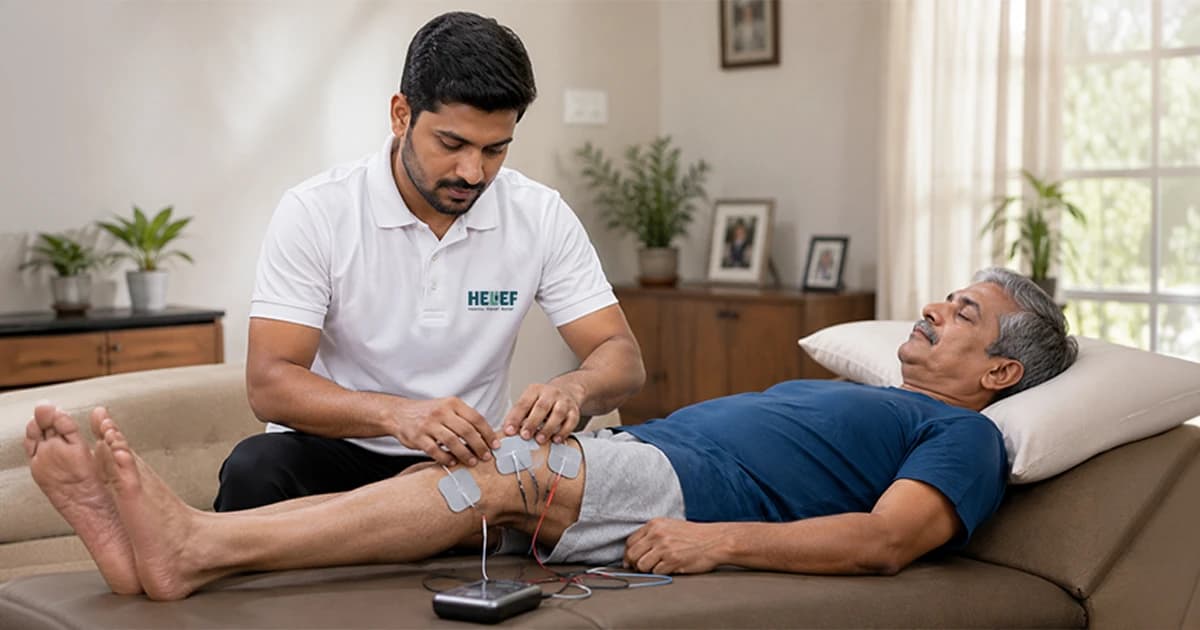
If you have had physiotherapy in India, there is a fair chance someone has attached four sticky pads to your back or knee, turned a dial until you felt a deep prickling, and left you there for fifteen minutes. That is IFT — and most patients finish a course of it without ever being told what it was doing.
This guide explains interferential therapy honestly: how it works, what the evidence actually supports, what it cannot fix, and when it is the wrong choice entirely.
What Is IFT?
IFT stands for interferential therapy, sometimes written as interferential current or IFC. It is a form of electrotherapy — treatment that passes a small electrical current through tissue to alter how you feel pain.
Two medium-frequency currents are delivered through separate pairs of electrodes, arranged so they cross inside the tissue. Where they meet they interfere with each other, and that interference produces a low-frequency effect at the point where the currents intersect.
The reason physiotherapists use this arrangement rather than a single current is practical: skin resists low-frequency current strongly, which is why low-frequency electrotherapy can sting at the surface before it reaches anything deep. Medium-frequency current passes through skin far more comfortably. Crossing two of them produces the low-frequency effect where it is wanted — deeper in — without the surface discomfort.
What Does It Feel Like?
A deep, spreading prickle or tingle, usually described as more comfortable than TENS. It should never be painful, and it should never burn.
The physiotherapist raises the intensity gradually and asks how it feels. Your feedback is the only control that matters — the correct dose is strong enough to feel clearly, never strong enough to hurt. Some machines sweep through a range of frequencies so the sensation shifts slightly, which reduces the way the body stops noticing a constant stimulus.
A typical session runs 10 to 20 minutes — long enough to be worth doing, short enough that it should never be the whole appointment.
What IFT Is Used For
IFT is a pain-management tool, used almost entirely for musculoskeletal problems:
- Low back pain and neck pain
- Knee pain, including osteoarthritis
- Shoulder pain and frozen shoulder
- Post-surgical pain, once the wound is closed and healed
- Muscle spasm around a painful joint
The mechanism is not fully settled, but the working explanations are that the stimulation interferes with pain signals travelling to the brain, and that it may prompt release of the body's own pain-relieving chemicals. Improved local circulation and reduced swelling are also frequently claimed, with weaker evidence behind them.
The Honest Part: What the Evidence Shows
This is where most pages about IFT stop being useful, so here is the straight version.
Research supports IFT for short-term pain relief, mainly when it is used alongside exercise rather than instead of it — and that distinction turns out to be the whole point. Studies comparing IFT plus exercise against exercise alone tend to show a modest additional benefit in pain scores in the early weeks. The quality of that research is mixed, and the effect is real but not dramatic.
What the evidence does not support is IFT as a treatment in its own right. Major clinical guidelines for low back pain do not recommend electrotherapy as a standalone treatment, and no serious guideline recommends a course of electrotherapy without active rehabilitation alongside it.
That distinction matters commercially as well as clinically. A patient who receives twelve sessions of IFT and nothing else has usually paid for twelve sessions of temporary comfort — pleasant, and gone by the next morning. The thing that changes a musculoskeletal problem over months is loading the tissue properly — graded exercise, strength work, and correcting how the joint is being used. IFT makes that work more tolerable in the early painful phase. It does not replace it.
If a provider offers you a package that is mostly electrotherapy, ask what the exercise plan is. If there isn't one, that is your answer.
IFT vs TENS: What's the Difference?
They are often confused because both pass current through electrodes to reduce pain.
TENS uses low-frequency current directly. It is cheap, portable, and widely sold for home use — you can buy one online this afternoon — but skin resists low-frequency current, so the sensation concentrates near the surface.
IFT uses two medium-frequency currents that cross, producing the therapeutic effect deeper in the tissue and more comfortably at the skin.
In practice, IFT is generally the better choice for deeper structures — a lumbar spine, a hip, a thick-muscled shoulder — while TENS is perfectly reasonable for more superficial pain and has the advantage that a patient can own the machine and use it whenever needed.
Neither is a cure. Both are comfort measures that buy you a window in which to do the real work.
Can You Have IFT at Home?
Yes. Portable IFT units are compact — smaller than a shoebox — and a home physiotherapist carries one in the bag along with everything else a session needs.
There is a genuine clinical advantage to doing it at home rather than in a clinic, and it has nothing to do with the machine. Electrotherapy works best immediately before movement, while the pain is dampened and the joint will tolerate more range. In a clinic you get the treatment, then travel home, and the window has often closed by the time you are somewhere you can exercise. At home the physiotherapist can settle a painful knee with IFT and then take you straight into the exercises that actually change it — in the room where you will be repeating them.
At Helief, IFT is used the way it should be: as part of a session, not as the session. Our orthopedic physiotherapy and chronic pain rehabilitation plans use it where it earns its place — typically early on, for conditions like back pain and knee pain, and less as strength returns.
Who Should Not Have IFT
Electrotherapy has real contraindications, and a physiotherapist should ask about all of these before the first application. Tell your physiotherapist if any apply to you:
- A pacemaker or any implanted electronic device — including implanted defibrillators and neurostimulators
- Pregnancy — IFT should not be applied over the abdomen or lower back
- Active cancer in the treatment area
- A known or suspected blood clot, or active thrombophlebitis
- The front of the neck — the current must not cross the carotid area
- Broken, infected, or actively inflamed skin at the electrode sites
- Reduced or absent sensation in the area — if you cannot reliably feel the current, you cannot report when it is too strong
- Undiagnosed pain — pain that has not been assessed should be assessed, not masked
Epilepsy, an implanted metal joint, and diabetes with nerve involvement do not automatically rule IFT out — but each needs a clinical judgement rather than a default yes.
What a Session Should Involve
If IFT is part of your treatment, a properly run session looks like this:
- Assessment first. Where the pain is, what provokes it, what the joint can currently do.
- Screening for contraindications — the list above, asked, not assumed.
- Electrode placement so the currents cross at the painful structure. Placement is a clinical decision, not a fixed pattern.
- Intensity set by your feedback, raised gradually to a clear but comfortable sensation.
- 10–20 minutes, with the physiotherapist checking in rather than disappearing.
- Exercise immediately afterwards, while the pain is reduced. This is the part that changes your outcome.
- A home programme you can do without the machine.
If steps 1, 6 and 7 are missing, you are being sold a machine rather than treated.
Frequently Asked Questions
Is IFT painful? No. It should feel like a strong but comfortable prickling or tingling, spreading through the area. If it stings sharply, burns, or causes the muscle to cramp, tell the physiotherapist straight away — the intensity is too high, or an electrode is sitting badly — neither is something to endure politely.
How many IFT sessions will I need? IFT is not counted in courses of its own, because it is an add-on rather than a treatment. It typically features in the early, most painful sessions of a plan and reduces as strength and movement return. If a provider quotes you a fixed package of electrotherapy sessions with no exercise component, ask why.
Does IFT cure back pain or arthritis? No. It reduces pain temporarily, which makes movement and exercise more tolerable. What improves back pain and arthritis over time is graded loading, strength work, and changing how the joint is used day to day. Any claim that electrotherapy alone resolves these conditions is not supported by evidence.
Is IFT safe for elderly patients? Generally yes, with the usual screening. Two things need particular care in older patients: reduced skin sensation, which makes their feedback on intensity less reliable, and thinner skin, which needs careful electrode contact. A physiotherapist experienced in elderly care will adjust for both.
Can I buy an IFT machine and use it myself at home? Portable units are sold, but self-treatment misses the two things that make electrotherapy useful — a diagnosis that confirms the pain is suitable for it, and correct electrode placement over the right structure. It also risks masking pain that should be investigated — the one thing electrotherapy is genuinely good at is hiding a symptom. If you want something to use between sessions, ask your physiotherapist whether TENS is appropriate for you.
How much does IFT cost in Bangalore? It is normally included in the session fee rather than billed separately by any reputable provider. A standard home physiotherapy session in Bangalore runs ₹650–₹1,250, and equipment used during that session should be part of it. Our guide to home physiotherapy cost in Bangalore breaks down what a session should include. Be cautious of providers who charge per modality — it creates an incentive to use machines rather than treat.
Not sure whether IFT is right for your condition? A Helief physiotherapist will assess you at home, explain what will help and what won't, and give you an honest treatment plan. Book a free assessment or message us on WhatsApp.