Multiple Sclerosis Physiotherapy at Home in Bangalore
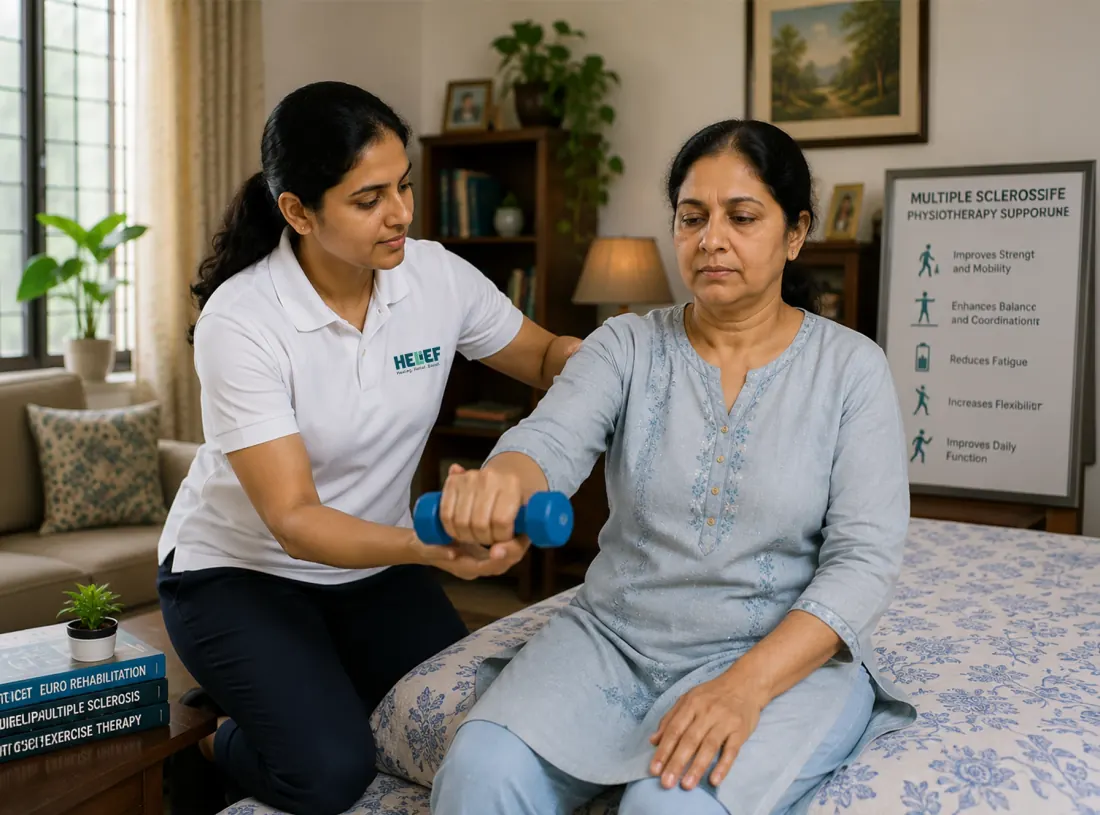
Multiple sclerosis affects everyone differently and changes over time — which is exactly why steady, adaptable physiotherapy helps so much. Our certified neuro physiotherapists bring evidence-based MS care to your home in Bangalore, helping manage fatigue, balance, and mobility so you stay active and independent.
- 5-Star Rated
- 100+ Happy Patients
- Certified Physiotherapists
Certified Physiotherapists
Verified & background-checked
Quick answer
Multiple sclerosis physiotherapy helps manage the symptoms that affect daily life — fatigue, muscle stiffness (spasticity), balance problems, and reduced mobility. Exercise is safe and beneficial in MS, and a tailored, well-paced programme helps maintain strength, mobility, and independence. Home-based care allows the plan to adapt around relapses, fatigue, and heat sensitivity.
Understanding it
What is multiple sclerosis?
Multiple sclerosis (MS) is a condition in which the immune system damages the protective covering around nerves in the brain and spinal cord, disrupting the signals between brain and body. Its effects vary widely from person to person and over time — fatigue, muscle weakness and stiffness, balance and walking difficulties, numbness, and problems with coordination are among the most common.
Physiotherapy is a cornerstone of managing MS well. It doesn't cure the condition, but the evidence is now clear that exercise is both safe and beneficial in MS — helping to manage fatigue, maintain strength and mobility, reduce spasticity, and improve balance and confidence. Because MS fluctuates, the value of physiotherapy is in a carefully paced, adaptable programme that works with the condition rather than against it.
Common symptoms
- Fatigue — often the most limiting symptom in MS
- Muscle weakness and stiffness or spasticity
- Balance problems and difficulty walking
- Numbness, tingling, or altered sensation
- Problems with coordination and fine movement
- Symptoms that come and go, or worsen with heat and tiredness
Common causes
- An immune-mediated attack on the protective myelin around nerves
- The exact trigger is not fully understood
- Genetic susceptibility in combination with environmental factors
- Low vitamin D and other environmental influences under research
- More common in younger to middle-aged adults, and in women
Risk factors
What raises the likelihood
Don't wait it out
When to see a physiotherapist
If any of these sound familiar, an assessment is worth booking. Treating it early usually means a faster, fuller recovery.
Soon after diagnosis, to build a safe, paced exercise routine
If fatigue, balance, or mobility are affecting daily life
After a relapse, to rebuild strength and function
If stiffness (spasticity) is limiting movement
At any stage — physiotherapy helps across the course of MS
Seek medical care first
These signs need a doctor or emergency care — not physiotherapy. Please get urgent medical attention if you notice:
- A significant new or worsening set of symptoms lasting more than a day (possible relapse — contact your neurologist)
- Sudden loss of vision, severe weakness, or loss of bladder/bowel control (seek urgent medical care)
- A fall causing injury, or new severe dizziness
- Fever with worsening symptoms (infection can worsen MS symptoms temporarily)
Our approach
How Helief treats multiple sclerosis at home
Every plan starts by understanding how MS affects you specifically — your fatigue levels, balance, strength, spasticity, and what you most want to keep doing — because no two people with MS are the same. Just as important is pacing: we build a programme that challenges you without triggering the overexertion or overheating that can cause temporary flares.
The work combines strength, balance, and mobility training with fatigue-management strategies and spasticity work, all adapted to how you're doing on any given day and around any relapses. We coach you on pacing and energy conservation, address fall risks in the home, and adjust the programme as the condition evolves — the flexibility that home-based care makes possible.
Treatment techniques
Evidence-based methods we use
Paced strength & endurance
Carefully graded strengthening and conditioning that builds capacity without triggering fatigue flares.
Balance & mobility training
Targeted balance and walking work to maintain mobility, confidence, and safety on the feet.
Fatigue & energy management
Practical pacing and energy-conservation strategies for MS's most limiting symptom.
Spasticity management
Stretching and movement to ease muscle stiffness, alongside any medical treatment prescribed.
Heat-aware, adaptable sessions
Programmes paced to avoid overheating and adapted around relapses and day-to-day variation.
Fall prevention & home safety
Addressing balance and home hazards to reduce the falls that balance problems can cause.
Recovery timeline
What progress typically looks like
Every recovery is individual — this is a general guide, not a guarantee. Your physiotherapist sets realistic milestones after the first assessment.
- 1First few weeks
Assess & pace
We assess your symptoms and build a paced, sustainable programme matched to your energy and goals.
- 2First few months
Build strength & balance
Steady gains in strength, balance, and mobility, with fatigue and pacing strategies embedded throughout.
- 3Around relapses
Adapt & recover
The programme flexes around relapses and flares, supporting recovery of function afterward.
- 4Ongoing
Maintain independence
Long-term, adaptable physiotherapy to maintain mobility, manage symptoms, and support independence.
Why at home
The advantage of treating multiple sclerosis at home
Sessions paced and timed around your fatigue and heat sensitivity, not a fixed clinic slot
No energy spent travelling — energy that MS makes precious
The programme adapts easily around relapses and day-to-day variation
Home fall hazards addressed directly where you live
Certified physiotherapists, clinical standards, delivered at home
Every multiple sclerosis treatment plan is delivered by a qualified, vetted physiotherapist following proper assessment and safety protocols — built around your goals and paced to your recovery.
Book Now
Start multiple sclerosis treatment at home
Share your details and we'll call you back to arrange a home visit across Bangalore. A certified physiotherapist assesses the cause before any treatment begins.
Locations we serve
Multiple Sclerosis physiotherapy across Bangalore
Our certified physiotherapists visit homes right across the city. Pick your area, or message us to check availability near you.
Not on the list? WhatsApp us — we cover much of Bangalore.
FAQ
Multiple Sclerosis — your questions
Related conditions
You may also be looking for
Stroke Rehabilitation
Rebuilding movement, strength, and independence after a stroke — at home in Bangalore.
Learn MoreParalysis
Restoring movement, preventing complications, and rebuilding independence after paralysis — at home.
Learn MoreParkinson's Disease
Maintaining movement, balance, and independence with Parkinson's — through home physiotherapy.
Learn MoreBell's Palsy
Facial retraining to restore movement and symmetry after Bell's palsy — at home.
Learn MoreStart your recovery journey this week
Book a home visit and let a certified physiotherapist come to you — no travel, no waiting rooms.