Bell's Palsy Physiotherapy at Home in Bangalore
Waking up with one side of your face weak or drooping is frightening — but Bell's palsy usually recovers, and the right facial retraining supports a fuller, smoother recovery. Our certified physiotherapists bring targeted Bell's palsy care to your home in Bangalore.
- 5-Star Rated
- 100+ Happy Patients
- Certified Physiotherapists
Certified Physiotherapists
Verified & background-checked
Quick answer
Bell's palsy physiotherapy uses facial exercises and neuromuscular retraining to restore movement and symmetry to the affected side of the face, and to prevent long-term problems such as tightness and unwanted linked movements (synkinesis). Most people recover well, and guided facial rehabilitation supports a fuller, smoother recovery.
Understanding it
What is bell's palsy?
Bell's palsy is a sudden weakness or paralysis of the muscles on one side of the face, caused by inflammation of the facial nerve. It often appears over hours or a day or two, and can make it hard to close an eye, smile, raise an eyebrow, or keep food and drink from escaping the mouth on that side. Although alarming, it is usually temporary — most people recover, many completely.
Physiotherapy supports that recovery through facial retraining. Rather than forceful exercise, the focus is on gentle, precise movements that reconnect the brain with the facial muscles as the nerve heals, restoring symmetry and control. Just as importantly, good retraining helps prevent the longer-term problems that can follow a poor recovery — tightness, and 'synkinesis', where one movement triggers another unintentionally.
Common symptoms
- Sudden weakness or drooping on one side of the face
- Difficulty closing the eye on the affected side
- An uneven smile or difficulty raising the eyebrow
- Food or drink escaping from the corner of the mouth
- Drooling, or difficulty with clear speech sounds
- In some cases, altered taste or sensitivity to sound
Common causes
- Inflammation and swelling of the facial nerve (the exact trigger is often unknown)
- A viral infection, commonly linked to the herpes simplex virus
- Recent viral illness or upper respiratory infection
- Pregnancy, particularly the third trimester
- Diabetes, which is associated with higher risk
- A weakened immune system or recent significant stress
Risk factors
What raises the likelihood
Don't wait it out
When to see a physiotherapist
If any of these sound familiar, an assessment is worth booking. Treating it early usually means a faster, fuller recovery.
Early in recovery, once Bell's palsy is diagnosed, for correct facial retraining
If your face isn't recovering as quickly as expected
If you're unsure how to exercise the face safely
If unwanted linked movements (synkinesis) are starting to appear
If an eye won't close fully and needs protecting (also see a doctor)
Seek medical care first
These signs need a doctor or emergency care — not physiotherapy. Please get urgent medical attention if you notice:
- Facial weakness with arm weakness or speech difficulty — this may be a STROKE, not Bell's palsy (call emergency services — think F.A.S.T.)
- Weakness affecting both sides of the face, or spreading to limbs
- A painful rash or blisters around the ear (may indicate a different diagnosis needing urgent care)
- An eye that cannot close, becoming red, painful, or with worsening vision (needs prompt eye care)
Our approach
How Helief treats bell's palsy at home
We start by assessing which facial movements are affected and how much, and by making sure the eye is protected if it can't close fully — an important early priority. Because Bell's palsy recovery is delicate, the approach is gentle and precise, not forceful, and always matched to the current stage of nerve recovery.
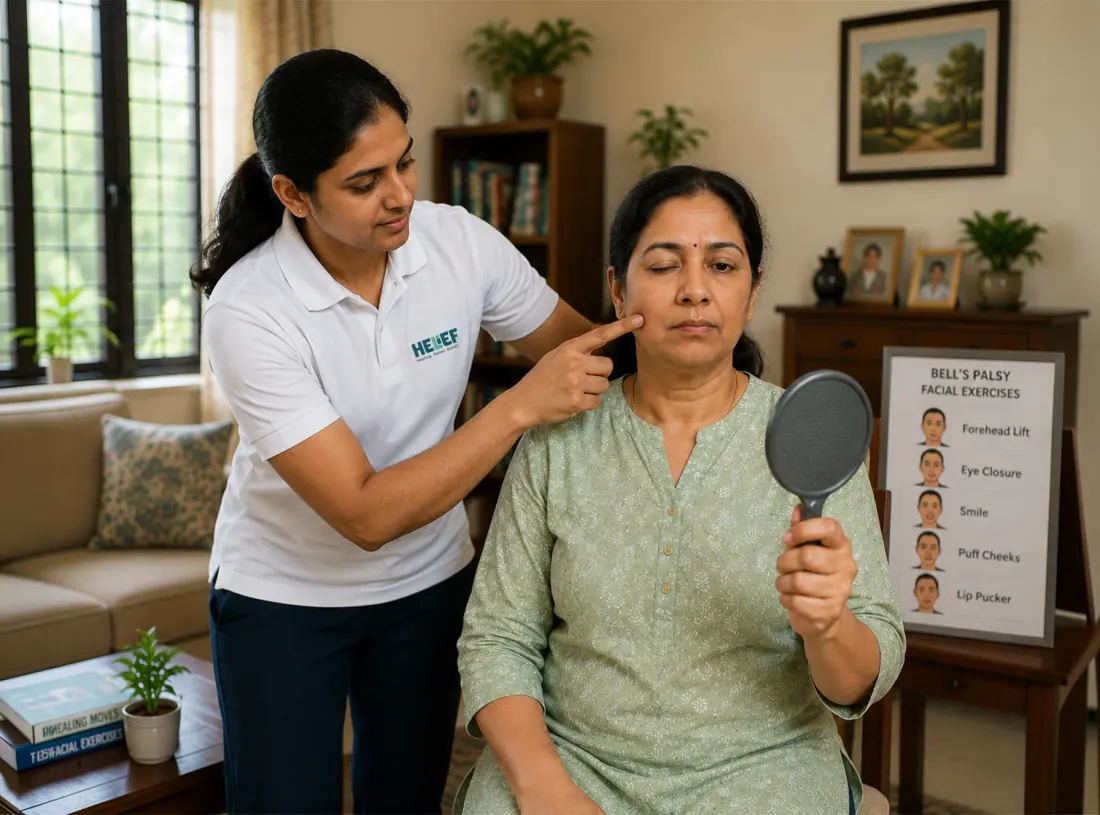
The core of treatment is facial neuromuscular retraining: guided, specific exercises in front of a mirror that reconnect the brain with the facial muscles, restore symmetry, and — crucially — avoid the over-activity that leads to synkinesis. We teach the exercises clearly so they can be practised correctly between sessions, which is where much of the progress is made.
Treatment techniques
Evidence-based methods we use
Facial neuromuscular retraining
Gentle, precise, mirror-guided exercises that reconnect the brain with the facial muscles as the nerve heals.
Symmetry & movement training
Targeted work to restore balanced movement — smiling, eye closure, eyebrow raise — on the affected side.
Synkinesis prevention
Careful, controlled retraining to avoid the unwanted linked movements that can follow a poor recovery.
Soft-tissue & relaxation techniques
Gentle massage and relaxation to ease tightness and support comfortable, controlled movement.
Eye protection guidance
Advice on protecting an eye that won't fully close, an important step while the nerve recovers.
Home exercise coaching
Clear, correct technique for daily practice — where much of the recovery in Bell's palsy is made.
Recovery timeline
What progress typically looks like
Every recovery is individual — this is a general guide, not a guarantee. Your physiotherapist sets realistic milestones after the first assessment.
- 1First 1–2 weeks
Protect & begin gently
Protect the eye if needed and begin gentle, correct facial retraining as the nerve inflammation settles.
- 2Weeks 2–8
Restore movement
As movement returns, precise retraining rebuilds symmetry and control while avoiding over-activity.
- 3Months 2–6
Refine & prevent synkinesis
Fine-tuning control and symmetry, and preventing unwanted linked movements as recovery consolidates.
- 4Ongoing
Full function
Most people recover well; where recovery is slower, continued retraining supports the best possible outcome.
Why at home
The advantage of treating bell's palsy at home
Mirror-based facial retraining coached in the comfort and privacy of home
No clinic trips while coping with a visible, unsettling facial change
Correct daily technique reinforced, which is where Bell's palsy recovery is made
One-on-one attention and reassurance through an anxious time
Certified physiotherapists, clinical standards, delivered at home
Every bell's palsy treatment plan is delivered by a qualified, vetted physiotherapist following proper assessment and safety protocols — built around your goals and paced to your recovery.
Book Now
Start bell's palsy treatment at home
Share your details and we'll call you back to arrange a home visit across Bangalore. A certified physiotherapist assesses the cause before any treatment begins.
Locations we serve
Bell's Palsy physiotherapy across Bangalore
Our certified physiotherapists visit homes right across the city. Pick your area, or message us to check availability near you.
Not on the list? WhatsApp us — we cover much of Bangalore.
FAQ
Bell's Palsy — your questions
Related conditions
You may also be looking for
Stroke Rehabilitation
Rebuilding movement, strength, and independence after a stroke — at home in Bangalore.
Learn MoreParkinson's Disease
Maintaining movement, balance, and independence with Parkinson's — through home physiotherapy.
Learn MoreMultiple Sclerosis
Managing fatigue, balance, and mobility with MS — through home physiotherapy.
Learn MoreParalysis
Restoring movement, preventing complications, and rebuilding independence after paralysis — at home.
Learn MoreStart your recovery journey this week
Book a home visit and let a certified physiotherapist come to you — no travel, no waiting rooms.